
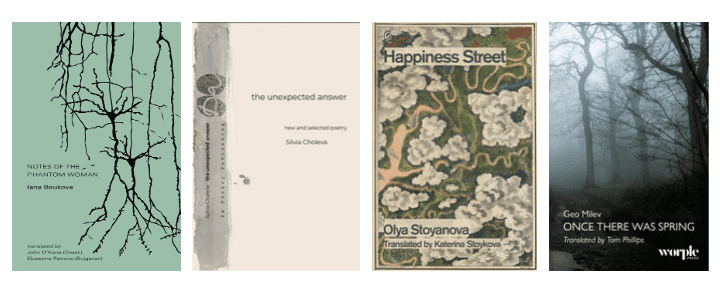
Drew Rollins and James Peake review four new books of contemporary Bulgarian poetry in translation. Edited by Clint Margrave.
There is not another writer like Iana Boukova, and one need read only a few pages of Notes of the Phantom Woman for that truth to rattle home. Occasionally, Boukova’s moves bring other poets to mind—Monica Youn’s intellectual rigor and formal inventiveness, Rita Dove’s ability to somehow address all of human history in the space of ten lines, Robert Pinsky’s eye for the perfect searing anecdote—but the final product is entirely her own, and absolutely stunning.
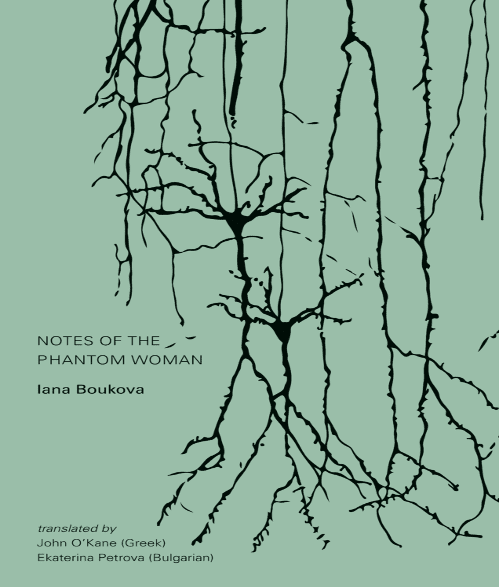
by Iana Boukova
Translated by John O’Kane, Ekaterina Petrova
Ugly Duckling Presse (2024)
88 pages
Initially published dually in Bulgarian and Greek, the collection was then translated by Ekaterina Petrova and John O’Kane, who collaborated to merge the original compositions into one phenomenal English version. Indeed, the Anglophone world owes Petrova and O’Kane (and Boukova, of course) a debt of gratitude, as the language is a total triumph: dense yet digestible, adorned yet unpretentious, unusual yet relatable. Take, for instance, “All is unattainable and somehow useless / like red-hot letters of Braille” or “The only way to photograph a snowflake / is to hold your breath.” It is the sort of project for which globality and translation have burnished, rather than tempered, an inherent shine.
Boukova is a whiz at pulling off one of my favorite poetic techniques: to present phenomena that seem unrelated, describe them poignantly, then evince their indisputable relationship. “The Evolution of Monsters in Children’s Literature” suggests that such relationships are almost unavoidable: “One of the most difficult things / to achieve is true randomness. / Numbers or events in a series / that do not form any pattern.” Everything is interconnected if you know how to look at it, which Boukova surely does. She tethers Scream to Duchamp, early hominins to sheep clones, String Theory to braised pork. In holding these (and other) concepts up—not only to the light, but also next to each other—she achieves a multiplicative effect, such that we understand them all better, and in deeper, more personal ways, than we otherwise might have.
Selecting favorites is difficult, but I’m partial to “Dog” and the numbered long poem “Umwelt.” In any case, the collection is best consumed in one fell swoop. Boukova always finds the perfect ending, some unforeseen crystalline focus with the power to alter, so, all this to say, if you want a perfect ending, well, perhaps you ought to stop reading this blurb. And go get a copy of Notes of the Phantom Woman.
— Drew Rollins
Silvia Choleva’s The Unexpected Answer draws from her previous collections and introduces new material to facilitate an eminently satisfying foray into a remarkable oeuvre. Brought over to English by a bevy of clever translators (and thank goodness they were clever!), the book makes the profane beautiful, the quotidian profound, and the reader think differently about all sorts of things. It is a masterwork of subtle revelation.
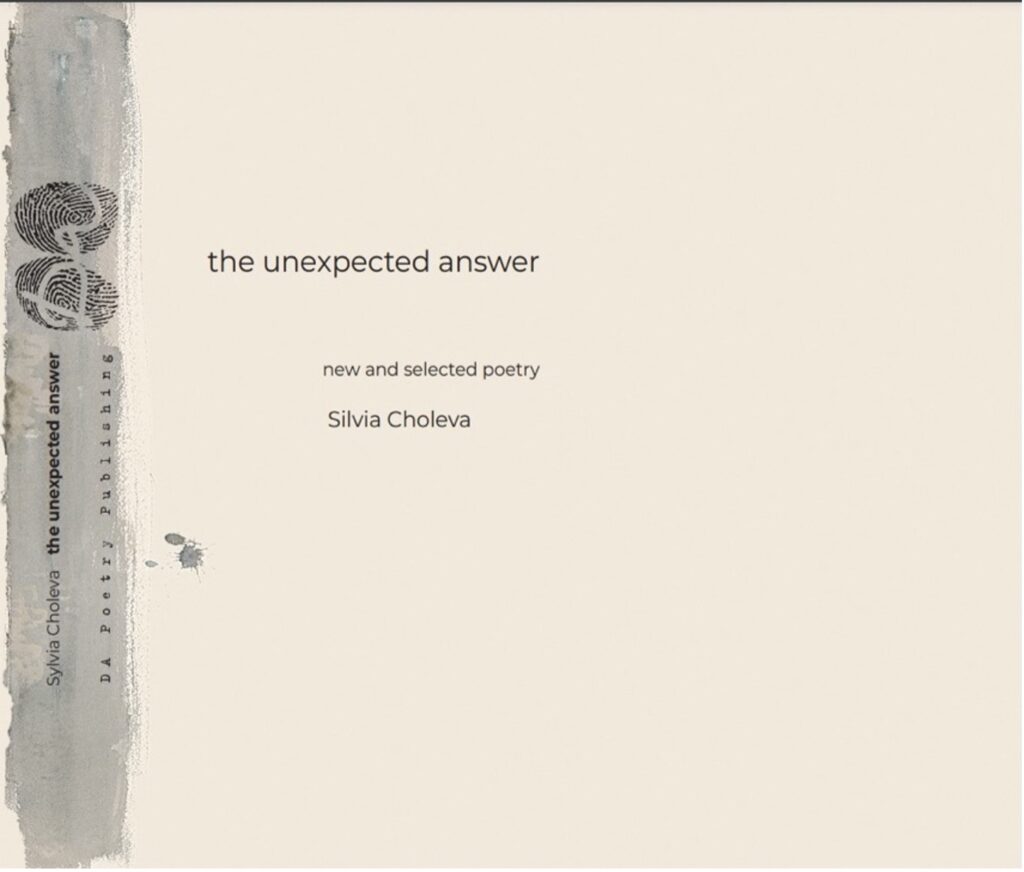
As is often the case with gifted writers, Choleva’s style can prove idiosyncratic. She eschews traditional punctuation; she capitalizes sparingly; her line lengths vary quite a bit; the titles of some poems are embedded, in boldface, within the first line; others take the shape of postcards. But in her deft hands, these choices never feel frivolous or confusing or anything but effective. Polysyndeton, enjambment, and catchy repeated phrases create a recognizable, ever-present rhythm, dutifully preserved by the translators. Each line is like a successful poemette unto itself. And, as big as its ideas are—grief, time, pain, purpose, every flavor of love—the collection is grounded in beautiful, accessible language (like “it passed / but it looks wild / as if everything were just about to begin”) and wonderfully memorable imagery (“sitting on the two blue chairs / in front of the whitewashed wall / I’ll soon grow old with you / or are simple pleasures not possible / fish and rosé / and exaltedness / just / because you exist”). Altogether, the reading experience is provocative yet supremely pleasant; the book is quiet yet resonant. These are rare balances to strike.
At times, I was reminded of Mark Strand, who is name-dropped in the impeccable “last night” (and whose fans would be wise to read Choleva). Other highlights include “the key locks of Compostela,” “the red dancer,” “village graveyard,” and, naturally, “Nobody reads poetry today” (did I mention how funny the book can be?).
Choleva writes that “it’s a luxury to live with a poem,” and I have to agree. How valuable it feels to live with her work, and how lucky. Her writing is of such a quality—comprised of fascinating notions, rendered just so—that, upon reading it, I would probably be seething with envy were there any room left in my heart, filled as it is with other emotions, like joy, and ache, and wonder, and whichever exact sentiment she sought to evoke.
— Drew Rollins
With Happiness Street, Olya Stoyanova proves herself to be an astute observer of the world and its inhabitants. She unearths excellent little truths, often things I had never considered before, and then manages to make them feel axiomatic. She crafts scenes, injects them with tension, and resolves the tension, or leaves it percolating just right. A series of moments coalesces into unforeseen significance. I quickly realized I could trust her.
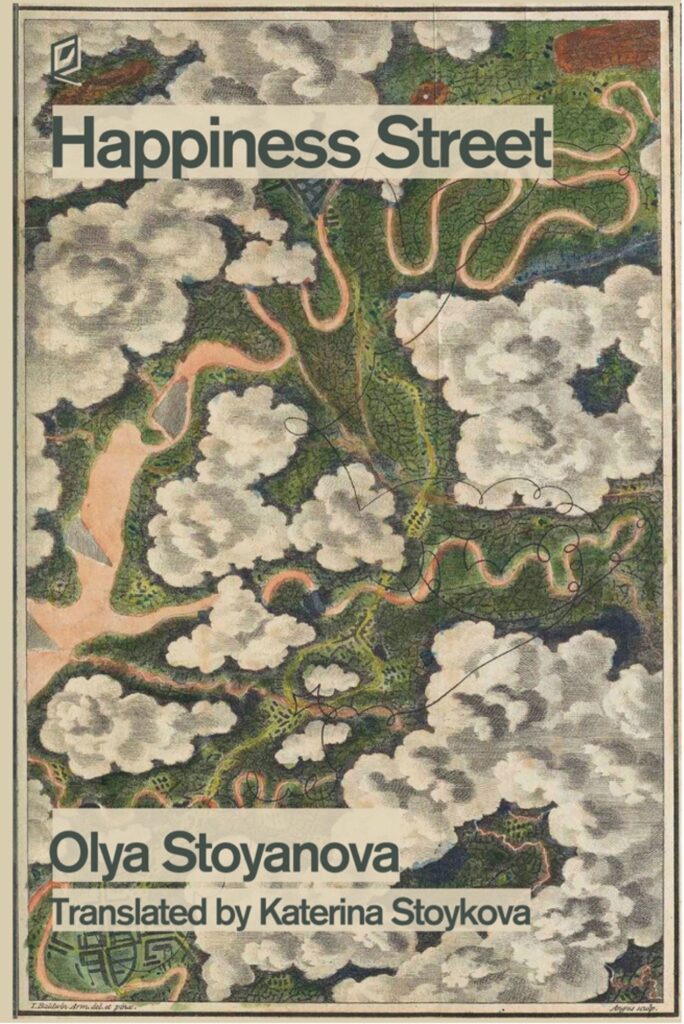
“Describing a Feeling” is an early example of Stoyanova’s admirable restraint, with stripped-back language serving to amplify a central concept. It reads, “Patience is / kneading bread which is not / going to be enough.” Every word is crucial; anything unnecessary is excised. What is left is emotion, and not just the one printed on the cover.
The titular poem frames the collection and illustrates the careful attention Stoyanova pays to place: “On this street / there is only one house— / old / and so low / that one must bow / to enter.” Throughout the 70ish pages, we visit (among other locales) the beach, a museum, a road market, a tea house at 2500 meters above sea level, Athens, Samarkand, Prague at noon, a church in a small tourist town, and the other end of the world. Here, places are vectors of knowledge, arenas for specific experiences, and enclosures that house believable people. But they also bear their own intrinsic value; meaning haunts their naves and nooks; they exist whether or not we perceive them. Fortunately, Stoyanova does perceive them, and coaxes beauty from their otherwise untapped acreage.
Katerina Stoykova does an outstanding job of conveying the Bulgarian text into natural, free-flowing, lovely English. Preserving sonic elements is always tricky, but in this translation, music abounds (as in “to not think of wrinkles / and the cold seasons of old age. / … only one more summer, and then I’ll rest” or “on the nose, / on the chin, / on the dignity / of years”).
Some of my favorite poems in Happiness Street are “End of Story,” “Personal Experience,” “Bread,” and “Autumn, 840 Meters Above Sea Level, Unexpectedly,” but you really cannot go wrong. Stoyanova’s voice is clear and powerful and confident, hovering somewhere between Charles Simic and Andrea Cohen, and yet singular and self-possessed. So listen up. I am glad I had the good fortune to.
— Drew Rollins
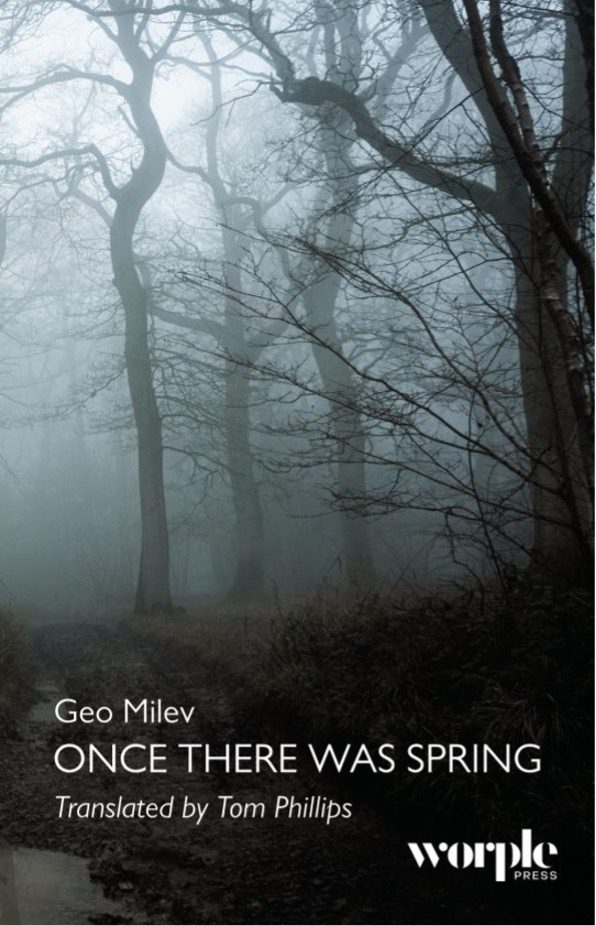
Geo Milev (1895-1925) was a major Bulgarian poet whose work has not been sufficiently available to English-speaking readers before now. Tom Phillips’ decision to translate Milev in full is admirable and successful. An illuminating introduction persuasively makes the case for international significance, and indeed parallels between 1922’s “Hell” and The Waste Land (a poem Milev would not have known) are, as Tom Phillips admits, “uncanny”. Poetic focus even falls to London, a place Milev knew from a brief spell there: “Beneath thick layers of fog/the Thames darkly flows”. Connoisseurs of the mystery of poetic convergence will have much to chew over.
I wished for an entire book again of his prose poems, fascinating thumbnails of frontline life and a valuable addition to our poetic knowledge of WW1. His compassion for a wounded Scottish soldier {“Unhappy son of the Highlands…pure of heart”), as well as his sense of the absurd (“…terrifying Bulgarians who are said to eat people”) seem emblematic of Milev’s openness as a writer. Some critical essays by him are also included. Very much the work of an ambitious young man, they show the range of Milev’s reading and his sense of a vast international lineage.
As a result of injuries sustained in a British bombardment Milev was fitted with a glass eye, the object by which he would be identified in a mass grave decades after he had been disappeared. In a bitter irony Milev was silenced by exactly the kind of political erasure he had always opposed. This important book begins the rebellion against that silence for English readers.
— James Peake
About the Reviewers:
DREW ROLLINS is a writer and translator who grew up in Maryland and Bulgaria. He recently graduated from Boston University’s MFA program in poetry and enjoys playing basketball, guitar, and little tricks.
JAMES PEAKE is the author of three collections of poetry, most recently The Third City (2025). He has worked for several major UK publishers and is now in independent podcasting. He lives in East Sussex, UK.