

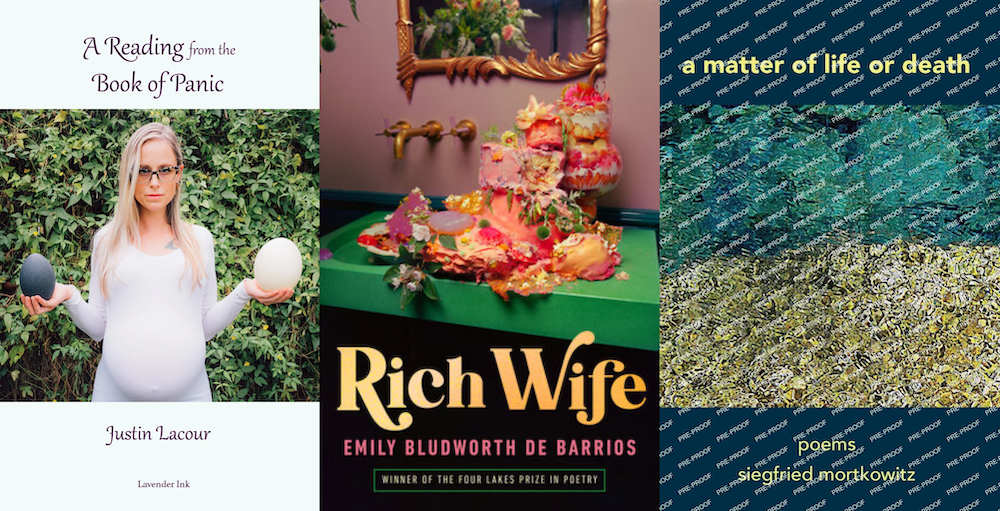
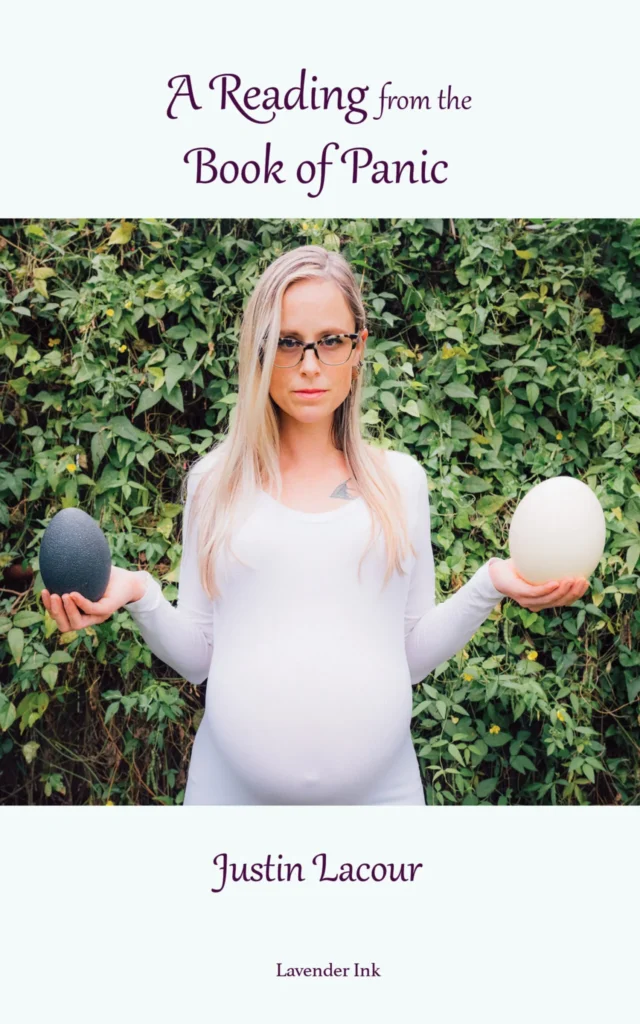
By Justin Lacour
Lavender Ink, 2025.
A Reading from the Book of Panic, Justin Lacour’s deeply serious first full-length collection, is a restless, honest book about panic, faith, marriage, and the slow work of becoming a better man. Dedicated to his wife Kate, the collection moves between autobiography, prayer, and love letter with a conversational urgency that feels less like performance than necessity. The poet writes, as he says, because he needs to talk.
The collection is organized into four sections. The first, “A Marriage” is a single sprawling poem in asterisked sections that retells Genesis through a domestic lens. The man, the woman, and the snake move through the garden, their story braided with the poet’s own: his anxiety disorder, his years of drinking, his fear of silence. The technique of collapsing biblical myth into lived experience risks sentimentality, but Lacour earns it through self-implicating honesty. He writes that something was already broken before the snake arrived, before the fruit — a recognition that dissolves the comfort of blaming any single fall.
The wound is evident from the start, as are the things the poet feels compelled to do in order to heal and understand.
“i’d like this poem to go and speak to my wife
not like i speak to my wife words that heal
all the years i was too panicked to go outside
except for work school beer the years i did
not write one word and hated even my own
body i’m not the god of this poem God does
not blackout and forget children no God made
the children a garden and let them name
everything the man the woman didn’t know
when everything was named and there was
silence what to do with the silence”
The second section gathers shorter poems that are among the collection’s most accomplished. “Devil Music” opens with a college-era act of generosity and arrives at loneliness and longing for grace:
“to make room for the song
that feels sometimes like the first snow,
amazing and terrifying,
that sounds sometimes like your voice
whispering It’s okay; I forgive you.”
“Crossroads” is perhaps the poem in which the collection’s central concerns most fully converge: faith, panic, marriage, loss, and grace are brought together in a single prayer addressed to God that absorbs hurricane damage, near-fatal drinking, and a devastating loss during pregnancy, all without collapsing into self-pity:
“Lord… You loved
me more when the obstetrician moved her
stethoscope over my wife’s belly and said i don’t
hear a heartbeat You said nothing till the next
day my wife and i knelt in the grass under the
Tree of Life looking for words it was autumn
but there was a summer wind and You were
there behind our backs screaming”
“Conversion”, a short breathless poem, addresses the poet’s ongoing panic attacks. Lacour is speaking to Jesus but the real conversion here is from certainty to acceptance of uncertainty where signs and signals are enough. He doesn’t need the panic to go away. Lacour reframes suffering not as punishment or obstacle but as participation, a position Lacour holds without either triumphalism or despair.
“Little motors: some love letters” is the collection’s longest and most formally adventurous section: a sequence of untitled, asterisk-separated lyric prose poems all addressed to his wife. The sequence is best read as a sustained act of attention: Lacour watching his wife read, make art, garden, argue, nurse, theorize, and grieve, and repeatedly acknowledging the limits of his own capacity to fully see or say any of it. The speaker’s self-doubt about his own art, set beside his wife’s creative force, generates the section’s central tension and tenderness. What holds the collection together is not theme so much as the poet’s voice and angle of attention: a man learning, slowly and imperfectly, to listen — to his wife, to God, to the world he hid from.
A Reading from the Book of Panic is a book of faith, a love poem, a recovery narrative, and a diary of a marriage rolled into one. It’s also a book about what it costs to start writing again after years of silence, and what becomes possible when you do.

By Emily Bludworth de Barrios
University of Wisconsin Press, 2025.
Emily Bludworth de Barrios’s Rich Wife, winner of the Four Lakes Prize in Poetry, is an exploration of how femininity, labor, and identity are shaped and constrained by inheritance. Structured in five parts: “Grandmother Worship”, “Collecting Sticks”, “Rich Wife”, “The Pelvic Bone”, and “Hera”, the collection traces a movement from generational erasure to mythic reimagining. Through personal history, cultural critique, and literary allusion, Bludworth de Barrios interrogates what women carry, what they’re allowed to pass down, and what might be remade.
The poem, “Collecting Sticks”, sets the lens through which readers can approach the entire collection, offering a quiet but searing meditation on how identity is inherited, erased, and rewritten along gendered lines. Boys are marked by their fathers’ names like permanent tattoos, proud emblems of legacy, while girls wear the same names like necklaces, soon replaced by those of their husbands. Mothers’ names, unlike fathers’, fall away entirely. As girls grow into women, they rebuild themselves into mothers from fragile materials, only to be forgotten again. The poem traces how gendered identity begins with difference, but cycles toward alignment, not as equality, but as submission.
In the long title poem “Rich Wife”, Bludworth de Barrios sharpens that focus through the figure of the rich wife who has, ostensibly, “made it” and the “invisible” women who serve her. The rich wife is disconnected, alienated, and an isolated character. The poet subtly shows how other women, cleaners, nannies, mothers at swim class, might see the rich wife as being complicit, someone who has bought her exemption from certain kinds of labor by trading away part of herself. The result is a silent divide, a complicity that isolates her from the very women she might otherwise stand beside.
This estrangement reaches a bodily and emotional depth in “The Pelvic Bone”, where childbirth becomes both a literal passage and a symbolic one. “Passing through the pelvic bone as if weeping vast tears of milk,” the poet writes, portraying motherhood as sacred and grotesque, intimate and annihilating. The mother gives everything: “I relinquish my legs, my lap, my arms, my hours of sleep.” This section doesn’t sentimentalize motherhood, it restores its visceral complexity.
Finally, in “Hera”, myth becomes both critique and possibility. Hera the goddess, constructed by patriarchal myth as vengeful and shrewish, is contrasted with Hera the poet’s daughter: “in a myth that has not yet been thought of.” This duality reflects the collection’s arc: women have long been defined by others, yet the possibility of self-authorship persists. Hera the girl “remains owner of the girl’s hand.”
Bludworth de Barrios writes with precision: layering lists, and motifs to evoke the cycles women move through and the traps they’re asked to call home. Her voice is steady, matter-of-fact but cutting, and capable of irony, empathy, and mythic scope. Rich Wife is a book of (self) observation and subtle resistance: a book that speaks to what is inherited, what is endured, and what might finally be possible.
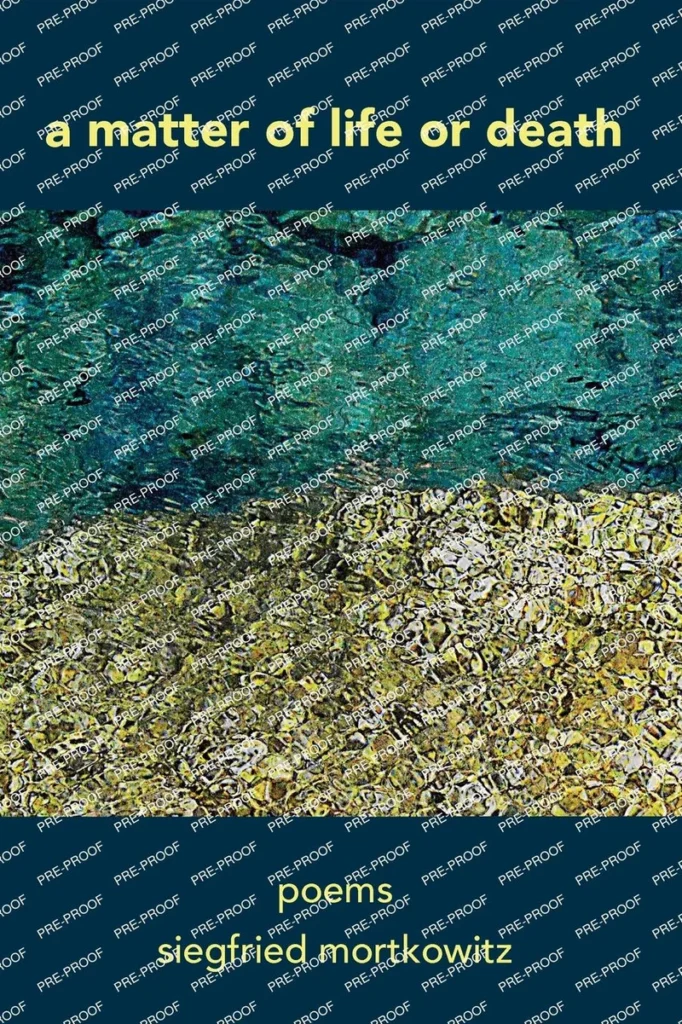
By Siegfried Mortkowitz
After Hours Press, 2026
Siegfried Mortkowitz is a poet of humour, directness, regret intermingled with refusal to regret, open-heartedness and a raconteur-like talent for storytelling. A Matter of Life and Death is broken into seven sections: “About Life”, “About the Holocaust”, “About the World”, “About Love”, “About Anything at All”, “About Me”, and “About Death”. This arc forms a life story of sorts with seminal moments, good and bad, woven together to create a colourful tapestry of humour, sadness, regret, memories, familial wounds and bonds, and the women Mortkowitz has loved and lost.
Mortkowitz writes from the perspective of someone who is constantly moving from one country to another, one city to another, one job to another, and one love to another through various circumstances and mood-weathers.
Many of his poems combine stark naturalistic truth with humour:
One day you’re up to your neck
in mud and ice, the next day,
you see a young woman
riding a bike in a miniskirt…
…It must be Spring,
the season of lust and murder
where every swollen shoot
and each indulged desire
is tainted with the fatality of winter.”
There’s a defiant bluntness to Mortkowitz’s voice and, although it becomes more tender when writing about old, lost loves, or his young son. His strength, however, lies in poems that take the form of rambunctious tales with a strange lived-in wisdom dotted throughout, as in “Eating Brains”:
“I had gone up early to the little chapel
between the pig farm and the wide Aegean,
now turning purple in the fading light,
because I wanted to see the ceremony
for Agios Ioannis before the party began…
…He told me to fetch the cases of retsina from the truck,
then to haul the chairs, ice for the beer and coal for the fires
on which five goats were being roasted…
….the sweet aroma of roasting
meat mingled with the perfume of thyme and sage
the seaward breeze carried down the mountainside
as darkness wrapped itself around the island…
I scooped out the beast’s brain and devoured it.
It tasted sweet and bitter, far better than I had feared…
The sun rose blood-red out of the water,
the light carving the whitecaps and low rollers
out of the dark block of night. And behind me,
somewhere on the rocky hill, a goat — my brother —
brayed at the light from his perch at the top of the world.”
Mortkowitz is a poet who writes straight from the heart of the human experience without pretension. He creates rich atmospheric scenes with a tone both conversational and intimate and takes the reader on an emotional narrative journey through a peripatetic life less ordinary.