
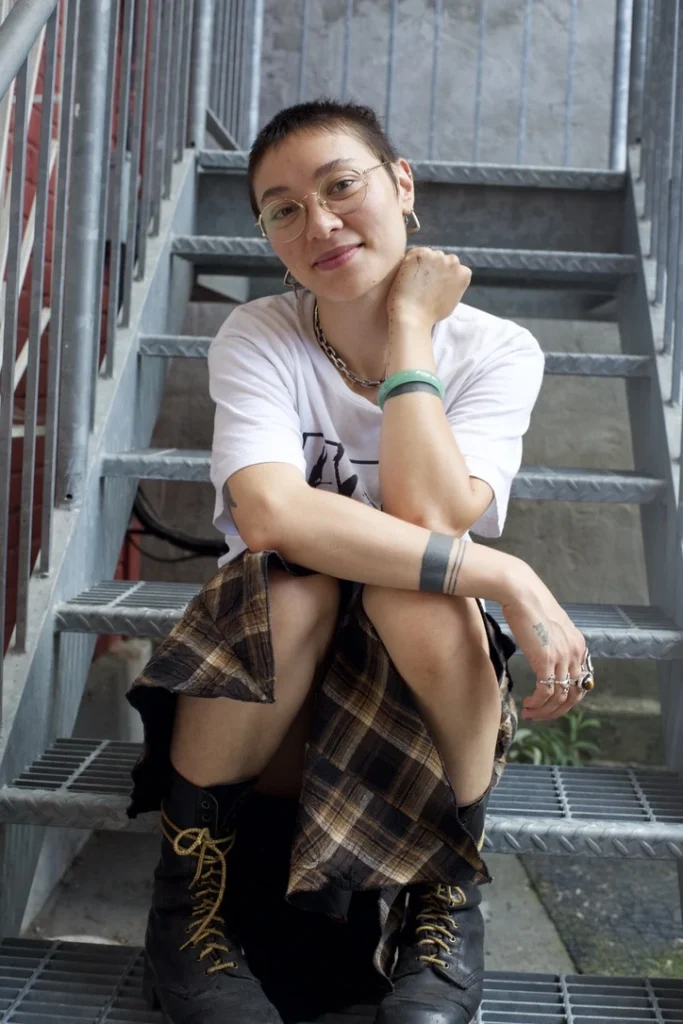
Moving between sound and performance, Be is a facilitator of music, dance and embodiment ritual. Their practice bridges dance training with expanded vocal techniques, sound healing, experimental music and conflict resolution.
As a vocalist and dancer, they collaborate across contemporary performance works that weave together voice, movement, and embodied presence.
Their choreographic practice explores alchemy and the hungry ghost, research in ancestral and queer lineages — together forming an inquiry into healing and alternative economies of care.
With the mission to connect people to their embodied wisdom and inherent luminosity, they have led workshops and classes across universities, festivals, artist-run studios, shelters, and community spaces across Turtle Island and Europe alongside founding The Singing Dancing Garden: a nomadic mystery school for song, dance, and the metaphysical arts.
B O D Y’s art editor, Jessica Mensch, caught up with Be Heintzman Hope recently to talk about their work and the thinking behind their artistic practice. The following interview has been edited and condensed for clarity.
B O D Y: Your work feels like a hybrid between therapeutic work and art. I’m wondering how you came to this – did you start by studying dance, or therapeutic forms of movement?
Be: I don’t really see the difference between them. I don’t understand the meaning of art if it’s not healing to some capacity. Of course, part of my story is that my mom has been sick with cancer since I was 14. When I was 19, it became terminal or stage four. So that had a huge effect on my attachment, my sense of trajectory in terms of what I’m doing with my life, as well as my relationship to the medical system. I understand myself, my family, and the world that I grew up in very much through that lens. I developed a lot of criticism around the Western medical system, medical racism, and dove into more holistic ways of working with the body.
Maybe before this, I had a different relationship to art. When my mum’s cancer was diagnosed as terminal, dance was the only place I felt like I could really release. It was an outlet where I could move my energy, emotions and grieve.
I think that the relationship I have to my body and my emotions is what allowed me to teach and facilitate a space that people call healing because of the kinds of ways I’ve learned to relate to myself through movement. The workshop space is something that I curate for other people to live more fully, break the trance of autopilot, cyclical thinking and connect to themselves and others in spirited and playful ways.
Video: Winnie Ho, Sound: Sasha Ford, Sound / video edits: Be Heintzman Hope
There’s a lot of transference that goes on when a parent is sick. My sibling and I have both struggled with stress-related alopecia. I’ve had seven bald spots in my life, and I have worked very hard to regain my health. Just dealing with that kind of stress, I unintentionally built a career based on regulating the system that is my body because it’s been impacted by stress for a long time, chronically and ancestrally.
I’m in need of structures and ancestral practices, which is why my next thing — and I’ve been doing it for a while — is studying Daoist medicine, Qigong, Tai Chi, Kung Fu, that whole martial aspect, to further inform the improvisation work I offer.
I’ve taken a step back from offering breath, voice and movement improvisation because of how loud the room can become with everyone’s stuff. We are playing, and if I don’t lay enough ground rules, people can just let it rip.
This is one of the reasons why I’m leaning more towards having structured movement practices for the time being before returning to more open improvisational scores. I want to deepen my understanding of breath patterns and extended vocal techniques to deepen the craft of how I score a workshop.
B O D Y: The following is the description for your course Stripper Gollum:
“This workshop plays with socialized notions of sexiness + the buddhist concept of the hungry ghost. Stripper Gollum serves as a mutable figure grappling with their feelings of emptiness, longings and the longings others have of them – in order to develop a compassionate humour towards both inner and outer hauntings.
This research asks: Is it possible that we may need to (be more gentle with?) move away from fixing “broken” parts of ourselves and instead embrace the inherent complexity of our many selves? If being whole doesn’t mean being consistent or predictable…can we embrace the complexity and diversity of our inner worlds, and recognize that everything is in a state of flux!?”
Would this course be an example of one that is more controlled and improvisational than others?
Be: It feels more controlled in a way, because of the structures that I have around it. I’m constantly revising this workshop and it also depends on who’s in the room and how comfortable I feel sharing something so close and personal to me. I’ve been teaching Stripper Gollum for five years, but I’ve been teaching breath voice and movement improvisation for 10. Five years is a long time. It’s also not 10 years.
I’m learning a lot about structure and improvisation — always. I’m constantly searching for the balance between these things — because we want to play, but also, what are we opening up? What’s our contingency plan once we’ve opened a certain truth or vulnerability? I sometimes work with very large groups of people. It’s not a one-on-one session. I don’t want to do one-on-one sessions. I love working with large groups, and I have the capacity to hold large groups so long as I’m not opening Pandora’s box. Structure keeps this in place.
B O D Y: What kind of research do you undertake while developing a course or movement composition?
Be: It’s really important that I resource myself. I write grants, or I save up, or take out a line of credit to take other people’s workshops. I’ve been doing that because I started teaching when I was in school, so I would be fed and nourished by my teachers. As my practice develops, as I develop, I’m drawn to different kinds of teachers, and I go and travel to meet them. So, I go to dance festivals all around the world, and I learn from different teachers. Doing that, I’ve met with people who can really hold that space or who have the capacity to. I’m going to study with Meredith Monk in December, and she’s 83 now. I went and did the same workshop last December, so it’ll be two years in a row that I’ve been able to do that. Meredith holds a room of 50 people singing, dancing, and meditating. So it’s very structured what we’re doing, and there can be space for improvisation. It does get kind of funky and hard sometimes, and it’s really beautiful how it unfolds. There are people who teach music in prisons, who are working with children in music schools or people who are musicians professionally. There’s a wide variety of people who are there. It’s a dynamic group of 50 people, and I’m one of the younger ones attending. I’ve had the opportunity to be in cohorts that are only for queer and trans people of colour, and artists working across a bunch of different mediums. There is often this aspect of healing and ancestral work. So, it’s no mystery that I’m holding a similar kind of container.
B O D Y: And creating those for other people in your workshops…
Be: Yeah, exactly. And then, of course, I read books on topics that support this work. I just finished reading The Art of Gathering: How We Meet and Why It Matters by Priya Parker. I’m constantly thinking about how we bring people together. What are we bonding over? et cetera. A lot of the personal work that I’ve had to do is reckoning with my mother’s impending death — I have thought that she was going to die so many times. So, I read this book called Caring for the Dying. It’s a book about being a Death Doula. It’s just pages and pages of death accounts, different people’s death stories and how they were assisted in their death process. For example, having all of their recipes compiled in a book near the end of life. Things that bring a family or community around a dying person to celebrate them while they are alive, as well as after they are gone. That, of course, affects how I hold or facilitate a space. How are we ending a workshop? Everything has a death. So, my mother’s illness and my relationship to death influence the work that I do as a facilitator and as a creator.
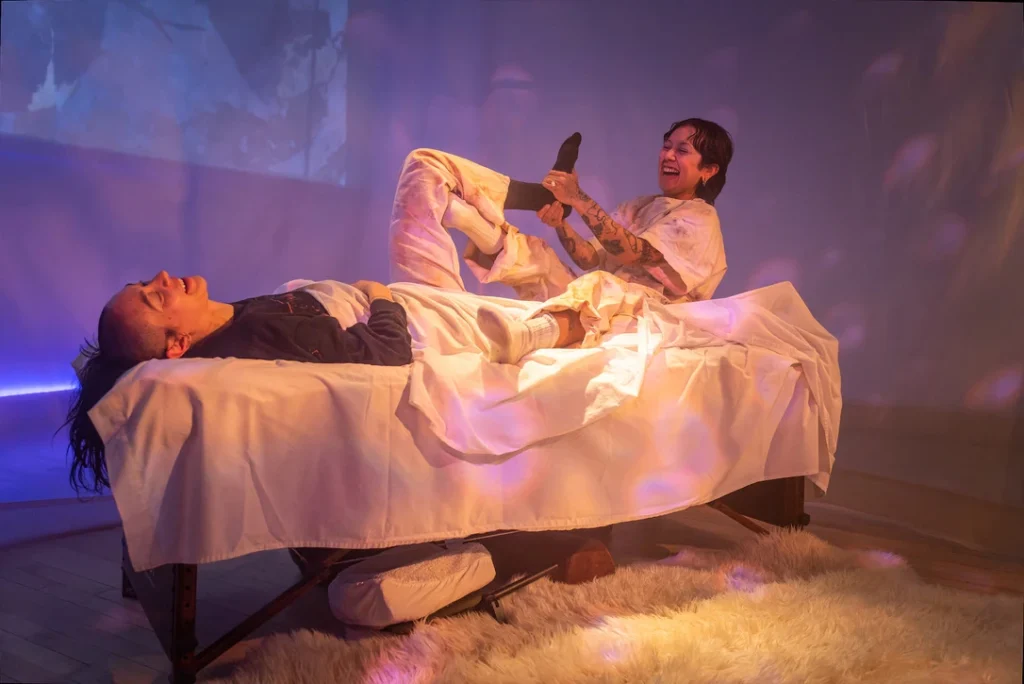
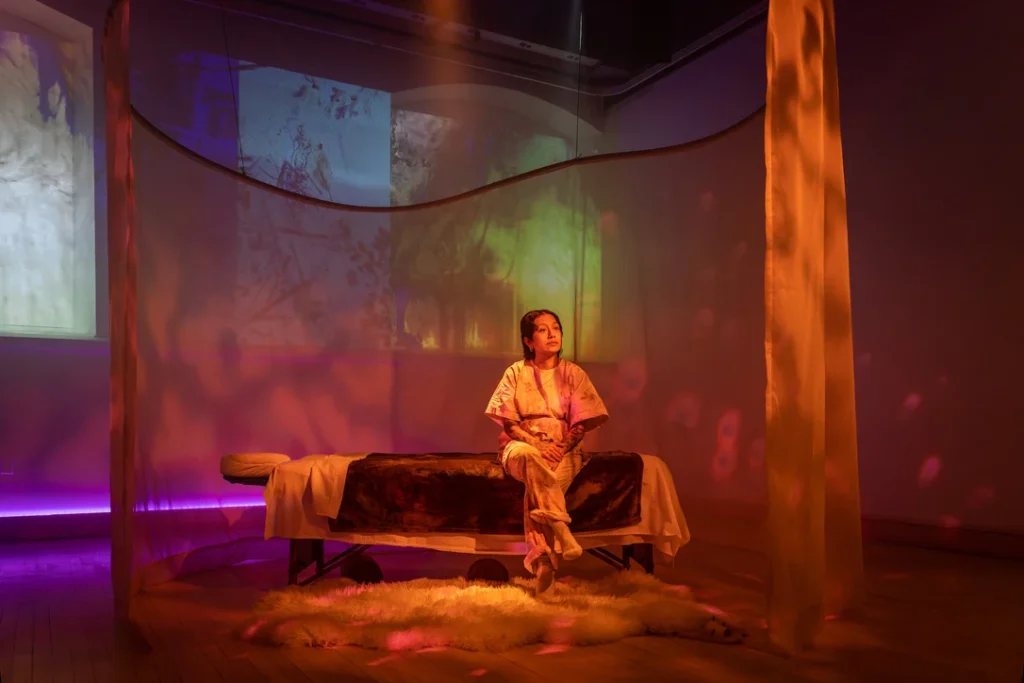
B O D Y: Could you talk a little bit about your work, Nurse Tree, a multimedia performance installation simulating an ephemeral care unit of queer and trans body workers that took place at MAI (Montreal, arts interculturels) in 2023?
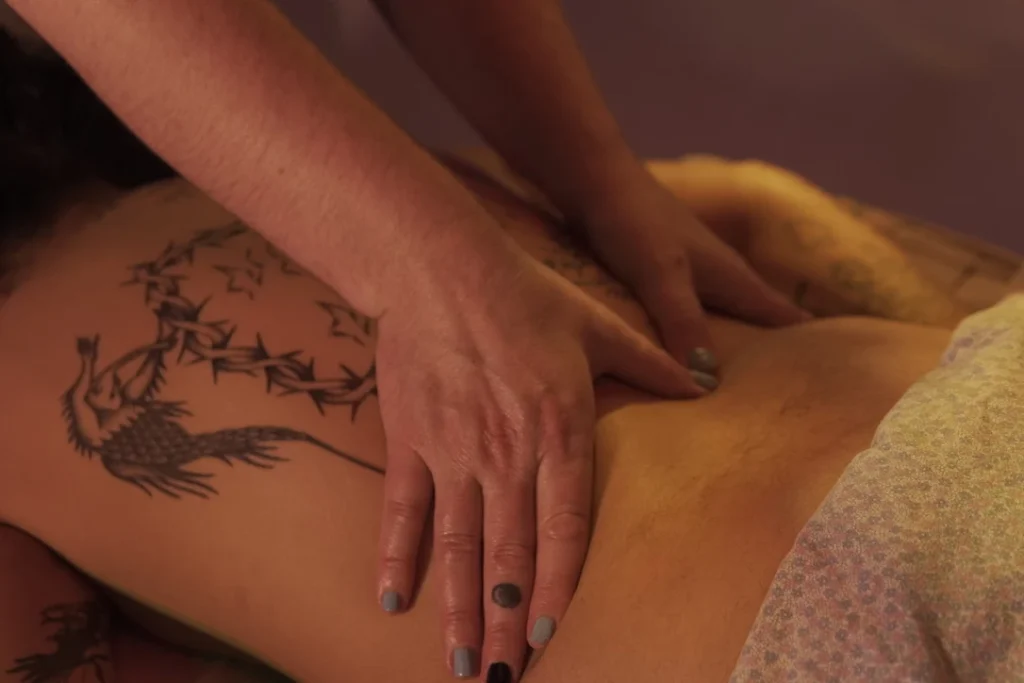
Be: Nurse Tree was born out of a dream for another kind of medical system. I have been with my mom in the hospital during very manipulative and traumatic interactions with doctors. My curiosity in Chinese and Daoist medicine as a young person was an attempt to try and heal her. As I began my life as a dancer, I was struggling with my own emotional health in relation to my mom’s illness. I became a part of the incredible queer and trans body worker community here in the city (Tio’tia:ke/Mooniyang/Montreal). I have met gorgeous people through giving my workshops, people who would take my workshop and be a fantastic astrologer, a body worker doing massage, doing tarot, doing reiki …
I began to do trades and exchanges with these other artists. As I was regulating my emotional health through these trades, I felt the reality that my health is so deeply intertwined with this ecosystem of body workers that are around me. It was such a beautiful gift. It’s always a beautiful gift for me to share workshops, but it was so much more intimate because there would be this energetic exchange of surrendering to the hands of a masseuse, who I could then hold in my workshop. Having this fantasy of, like, what would it be like if we liked going to the hospital? Because that’s how I feel when I go and I have a massage. And I’m like, OH MY GOD what would it feel like if my mom were to surrender to the doctor’s hands? To trust that blade?
I want to imagine a world like that. And so Nurse Tree came from this place of dreaming. As a young person spending a lot of time in hospitals, I was like, why isn’t there a piano? Why isn’t there a library? Why is it so cold?
B O D Y: As though these things aren’t a part of healing …
Be: Absolutely. Things that make people want to live! So that’s another thing that came up with the videos in the installation. My ex and I collaborated on a series of somatic workout videos that were there to echo TV shows playing in hospitals. Instead of Friends (the sitcom) or whatever new was playing, we created this offering of a tongue-in-cheek somatic workout, guiding people back into their bodies or into their breath: something I have done in real life with my family members in the hospital at various crisis points. These videos were a way of taking visual hospital noise and making it into something that could be helpful and make you feel better. I wanted to bring embodiment tools that I’ve learned onto the screen.
B O D Y: So the projections in Nurse Tree are somatic workout videos.
Be: Yeah, some of them are more like short films. Nurse Tree was really about this relationship to body workers and self. And the videos are like this relationship to the screen, and Switch (meditations on crying), the solo dance performance, is about the relationship to self and shadows.
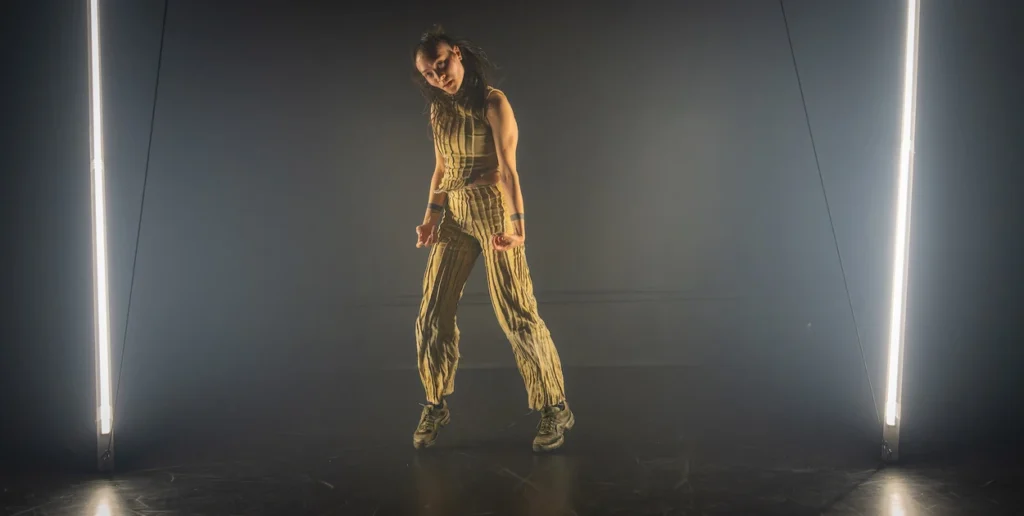
In Switch (meditations on crying), I hold questions: How quickly can you shift from one state to the next? How quickly can you put on your armour? How quickly can you take it off? The dance is kind of erratic, like having a moment where I’m feeling myself and then glitching through extreme states of shaking and barking. It’s very guttural and also self-soothing. It’s alchemizing a lot of negative experiences that can store themselves inside the body.
B O D Y: Where did your workshop, Stripper Gollum, come from? And do you see it evolving into an installation like Nurse Tree?
Be: That would be interesting.
Well, it started off as a workshop. The choreographic methods influenced the solo dance performance that I was making and vice versa. They fed each other. It also came from a lot of playfulness and honesty, and just dancing with my roommates. Playing with these quick switches. But it is also quite deep, coming from a time when I was no longer working as a stripper and reflecting on my experience as a stripper, and all of the things that led me to strip in the first place. How my life groomed me for this, and how many people’s lives groom them to be a stripper or SWER and have those skills. There’s this paradox of loving it and despising it at the same time. I think about stripping in many different ways — metaphorically, literally, metaphysically, being the object of desire, objectifying other people for my own desire. Getting into Gabor Maté’s In the Realm of Hungry Ghosts, has supported my reflection on this, addiction, how that exists in my own family, and how I’ve been around hard drugs for a very long time. I grew up in Vancouver’s downtown East Side. I find out that someone I know has overdosed most times I go back to visit.
Over the past 10+ years I’ve been getting more into Daoist and Buddhist practices of meditation and medicine, contemplating the realm of hungry ghosts that Gabor Maté was inspired by. These shadow spaces, this deep well of emptiness that can be inherited as well as produced by trauma and how people’s wounds and unmet needs can make them insatiable. In Stripper Gollum we tap into the theatrical spirit of our own insatiability, our ancestral insatiability as a form of zooming in and out through dance.
B O D Y: You mentioned how, when it comes to erotic dance, it’s akin to a conversation between the watcher and the performer. I can see how this could feel more intimate than a therapeutic interaction you might have with a doctor or therapist. Where does the erotic exist for you in relation to healing practices and dance?
Be: When I was younger and first getting into dance, I read a lot about trance dance.
B O D Y: What is that?
Be: It exists in different cultures. I remember reading about and watching documentaries on Balinese trance dance. Trance dancers go under a spell and dance for people, and there’s no thought involved consciously. It’s so primal. It’s energetic, it’s emotional. It’s all of these different things. It’s offering a service to the community by going into this state, and so when creating workshops, I want to facilitate an environment where people can take turns in different kinds of states. That’s why I call myself a facilitator of embodiment rituals, because everyone has a right to go under and be witnessed in that, in the unthinkable, in the illogical, in this spirit realm.
You can be going through so many different things, and it’s also safe because you’re not touching. You’re not interacting any more than bearing witness. And so in that way, there’s an auric shield protecting both the performer as well as the audience from one another. This is different from someone getting in there and doing therapy, because then you’re getting into their stuff. As a witness, you’re watching someone unfold through their process.

In Daoist and Buddhist cultures, there are hungry ghost festivals. It’s a time when the hungry ghosts are celebrated and seen, and protection spells are cast. The hungry ghost festival honours the deceased and spirits that wander the living world. It’s a time to reflect on one’s own craving and be especially mindful that it isn’t in the steering wheel of your life. Western culture can be very Dr. Jekyll and Mr. Hyde because people don’t want to reckon with their shadows. There’s more peace in cultures where people are actively doing shadow work on a collective level because they’re not trying to pretend that shadows, inner demons and unwholesomeness don’t exist. They’re not relegating them to a therapy room where they’re paying $140 an hour. They’re embedded in the culture. It’s spiritual warfare out here. As a diasporic individual whose family had to work very hard to assimilate – it’s my work to trace my lineage for wisdom practices we lost in the grind of assimilation. It’s a mosaic that I’m scrapbooking back together.
B O D Y: So it’s really a practice of integrating these things. Having taken several of your courses, the most revelatory aspect was going into a shared space and experiencing things in myself and in others that I didn’t really have any clear categories for. It opened me up in a way that I carried forward into the rest of my life.
Be: Yeah. I experienced such deep numbing in my adolescence. Where I just didn’t feel anything. I didn’t want to feel anything because of depression, anxiety, and fear. I was just shoving emotions down with different addictions and things like that. When I began to dance again, I opened a newspaper after class, and I just started sobbing. Through moving, I was able to feel again. I felt things that I wouldn’t let myself feel because I was afraid that I wouldn’t be able to function once I tapped into my emotional world. I was afraid that everything would fall apart. So many people are existing like this, and it’s detrimental to our collective emotional intelligence. We’re all vulnerable to it. I still do it, and I’m still trying to wake up.
— Jessica Mensch